

19 August @ 6:00 pm – 8:30 pm
6 for 6:30 pm
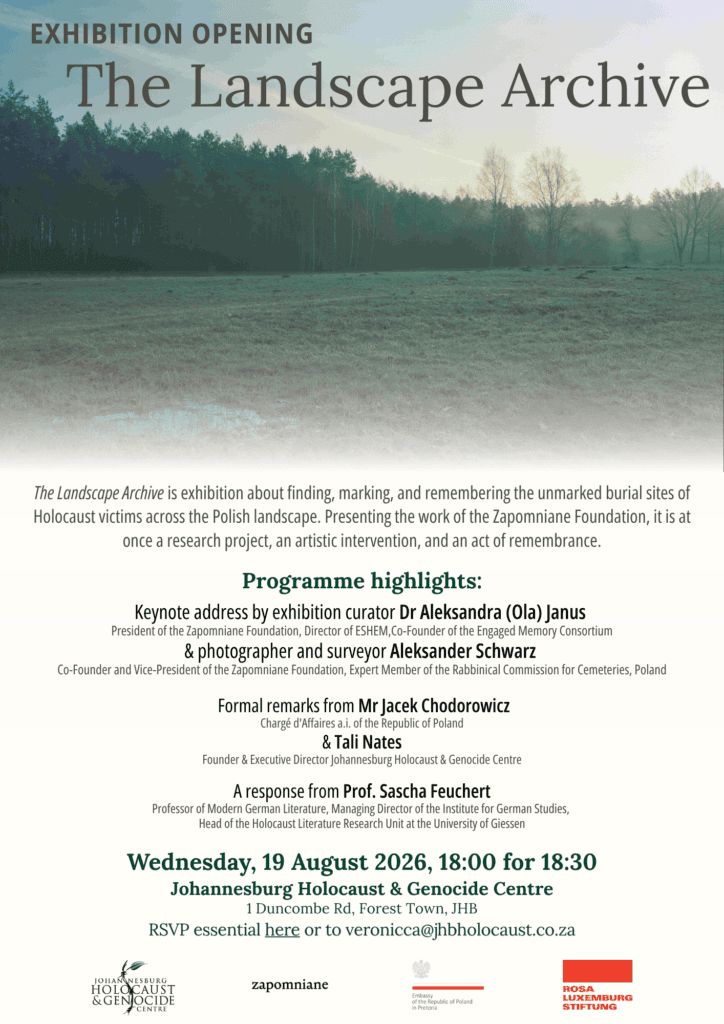
Beyond the major killing centres, thousands of Jewish people were murdered in forests, fields and by roadsides across Poland. Many were buried where they fell, in graves that were never marked. Hundreds of these sites remain unmarked to this day.
The Landscape Archive reveals a lesser-known landscape of the Holocaust: the hundreds of unmarked burial sites of Jewish victims scattered across forests, fields, and roadsides in Poland. While the Holocaust is often associated with major killing centres such as Auschwitz or Treblinka, thousands of people were murdered in countless other places while hiding, escaping, or during deportations. Many of these graves remain unmarked to this day.
The exhibition presents the work of the Zapomniane Foundation, which combines historical research with non-invasive technologies to locate and document these burial sites in accordance with Jewish religious law (Halakha). Through photographs, precise geographical coordinates, and visual documentation, The Landscape Archive uncovers traces of violence still embedded in the contemporary landscape of Poland. At once a research project, an artistic intervention, and an act of remembrance, the exhibition invites visitors to reconsider how the Holocaust continues to shape the places that surround us.
Programme highlights
Keynote address by exhibition curator Dr Aleksandra (Ola) Janus and photographer and surveyor Aleksander Schwarz
Formal remarks from Mr Jacek Chodorowicz (Chargé d’Affaires a.i. of the Republic of Poland) and Tali Nates (Founder & Executive Director Johannesburg Holocaust & Genocide Centre).
A response from Prof. Sascha Feuchert (Professor of Modern German Literature, Managing Director of the Institute for German Studies, Head of the Holocaust Literature Research Unit at the University of Giessen)
A walkabout of the exhibition
The keynote speakers
Aleksandra (Ola) Janus works at the intersection of academia, art, and activism. She holds a PhD in Anthropology from the Jagiellonian University in Kraków, Poland. She is the Director of ESHEM: European Sites of Holocaust Memory, a European Commission initiative, President of the Zapomniane Foundation, and co-founder of the Engaged Memory Consortium, which develops innovative approaches to remembrance.
She is a collaborator with the Research Center for Memory Cultures at the Jagiellonian University, a member of the global network Thinking Through the Museum, and serves on the editorial board of the Jagiellonian University/Columbia University Press book series Exhibiting Theory. She initiated numerous cultural projects, including Museum Lab (2014), Open Culture Studio (2016), Kultur-Lige – a network of contemporary Jewish artists in Poland (2023) – and the Museums for the Climate working group and Culture for Climate collective (2020), within which she co-authored the guidebook Culture for Climate.
She is the author and editor of numerous academic articles and publications, including Hideouts. Architecture of Survival (Hatje Cantz, Berlin, 2024), and the co-editor of a two-volume Polish-language publication on “non-sites of memory.” She has co-created exhibitions including Natalia Romik’s Hideouts. Architecture of Survival (Warsaw and Szczecin, 2022; Frankfurt, 2024), and curated exhibitions such as Landscape Archive (Brussels and Mechelen, 2025) and Miła: The State of Things (Warsaw, 2026).
Aleksander Schwarz is the co-founder and vice-president of the Zapomniane Foundation, long-term member of the Rabbinical Commission for Cemeteries (Office of the Chief Rabbi of Poland), where he works as an expert on Jewish law (Halacha) specializing in cemeteries and burials. Responsible for defining historical boundaries of cemeteries and their burial zones and identifying mass graves of Jewish victims of the Holocaust, using forensic analysis and non-invasive methods such as GPR (ground penetrating radar), LIDAR analysis, aerial photos interpretation and synchronization of archival maps. He collaborates with experts from AGH University of Science and Technology in Cracow and Warsaw University of Technology. He supervised the archeological and construction works in most of the sites of the former Nazi camps in Poland, including: Bełżec, Sobibór, Auschwitz, Majdanek, Treblinka as well as site of the former KL Plaszow camp (Kraków), Chełmno (Kulmhof) and many others.
He runs workshops and gives talks on Jewish law and non-invasive methodology of studying material traces of the Holocaust. He works with diverse audiences: schoolchildren, students, teachers, religious groups and groups of people affected by social exclusion, including prisoners (within the Atlantis Project, 2005-2009 and Tikkun Repair, 2009-2014).
He recently co-created several artistic research projects such as: „Speculative Cartographies” (Biennale Warszawa, Poland, 2019; NSCAD Halifax, Canada 2022), participated in exhibitions: „Knowing materiality” 2021 (Re:Kultura, Kraków), „Reference Points” 2021 (CentrALT, Kraków). He also contributed artistic-research materials for the exhibition „(post-)Jewish” at POLIN Museum of the History of Polish Jews (2024).