

2 November @ 6:00 pm – 7:30 pm
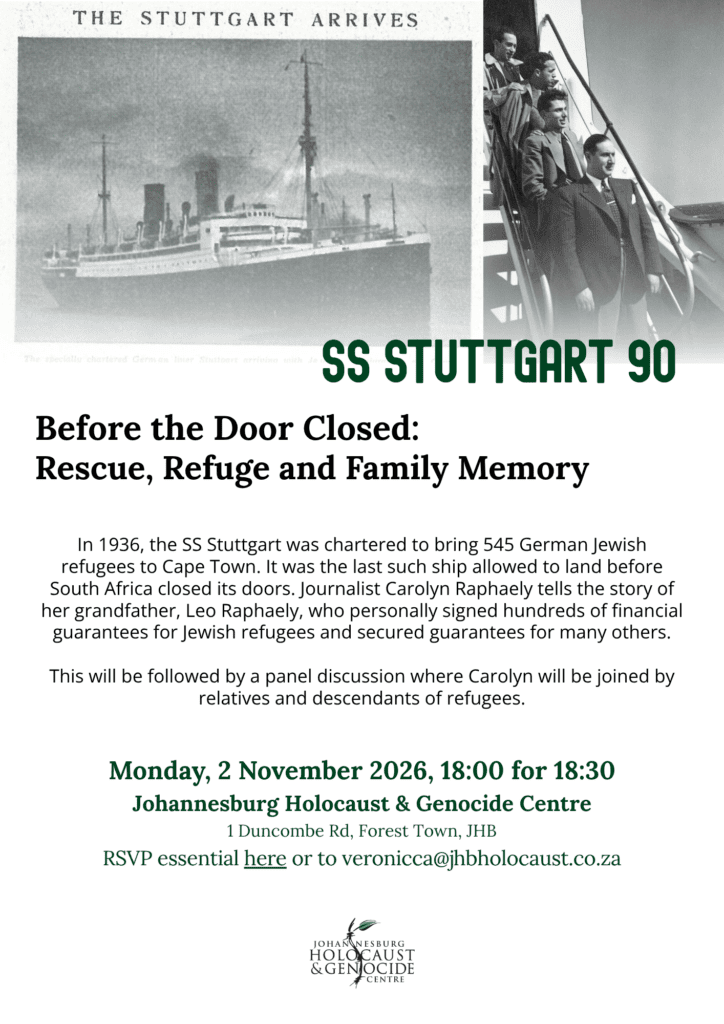
In 1936, the SS Stuttgart was chartered to bring 545 German Jewish refugees to Cape Town, the last ship carrying German Jewish immigrants permitted to land on South African soil before restrictive immigration legislation came into effect four days later and the gates closed.
On arrival, these benighted passengers discovered they had landed in a politically hostile environment, were viewed as an economic threat, and that the Stuttgart had become a symbol of resistance to Jewish immigration.
Shortly after Hitler came to power in 1933, Cape Town-based German Jewish businessman Leo Raphaely wrote to a cousin in Germany, urging her to flee antisemitism and resettle in South Africa. His letter outlined a loophole that allowed German Jews to immigrate with only a valid passport and a £100 guarantee signed by a South African citizen. Serendipitously, it was forwarded to the Hilfsverein der Deutschen Juden (German Jewish Aid Society) and widely circulated amongst Jewish communities across Germany, ultimately culminating in the charter of the Stuttgart three years later. A trickle of requests for help soon turned into a torrent. Leo personally provided, or secured, financial guarantees for every one of the 545 passengers, and through the SA German Relief Fund he established, raised funds, navigated official bureaucracy, greeted the new arrivals, and organised jobs and accommodation for them in local homes, including his own.
The Stuttgart saga should not be forgotten, not least because of the parallels between the perceived threat of foreign nationals competing for jobs in 1936 and the March and March-incited anti-immigrant fervour gripping South Africa today. The enormous impact these passengers and their descendants have had on South African society over the past ninety years provides a salutary lesson about the treatment of strangers in a strange land.
Ninety years on, award-winning journalist Carolyn Raphaely tells the story of the man who helped make that voyage possible: her grandfather, Leo Raphaely. This will be followed by a panel discussion where Carolyn will be joined by relatives and descendants of refugees.
About the speaker
Carolyn Raphaely’s career spans roles as Associate Editor of the Financial Mail, Features Editor of Finance Week and Johannesburg Bureau Chief of Cosmopolitan. For ten years she was a Senior Journalist with the Wits Justice Project, investigating torture behind bars and wrongful convictions, and assisted five wrongfully convicted men whose murder convictions were overturned by the Constitutional Court. She was named Webber Wentzel Legal Journalist of the Year and received an Honourable Mention for the World Justice Forum’s Anthony Lewis Prize for Exceptional Rule of Law Journalism.